
Reading
At St Mary’s, we value the importance of children becoming lifelong readers who are able to successfully comprehend and understand a wide range of texts. But more than that, we believe in the magic of a book! The way it can spark a child’s imagination, open doors to new worlds and create lasting moments of joy and discovery.
At the heart of our reading culture is our drive to foster a true love of reading. We enrich children’s learning through inspiring reading areas and carefully designed activities that make the most of high-quality fiction and non-fiction texts. We want children to find joy in books, to talk confidently about stories and authors and to feel a genuine excitement each time they turn a page.
Our aim is to provide every child with access to inclusive and representative literature that reflects the diverse society we live in. We want every pupil to feel seen, heard and valued in the stories they read. Through this, we hope to deepen their understanding of the wider world and nurture empathy, curiosity and a sense of belonging.
Reading is at the core of our curriculum. It underpins all learning and lays the foundation for future success. By contextualising knowledge and skills through our engaging English teaching, we aim to inspire every child to become the best speaker, reader and writer they can be, not only in our school setting but beyond.
Reading for pleasure at St Mary’s
- Daily story time
- Reading for Pleasure books
- Model a love for reading by staff
· Book talk
· Engaging book corners in every classroom
- Class novels
- World Book Day celebrations and dressing up
- Participaction in Wimbledon Book Fest
- Author visits
- Visits to school library
- Visits to local Merton Library
· Reading Librarians in Year 6
· Reading buddies between year groups
- Role-play/drama within lessons to bring stories to life
- Drama workshops
- Reading volunteers, including stories in different languages
· Participation in local reading competitions including the Summer Reading Challenge
Reciprocal Reading
Reading is more than just sounding out words on a page. Children need to develop fluency, confidence, and, most importantly, understanding. We teach these essential skills through weekly Reciprocal Reading lessons, which take place from Nursery through to Year 6 and are structured around whole class discussion which correlates with the latest Reading Framework. Children are exposed to different question types under the headings of LOOK, THINK and CLUE.
Through these lessons, we:
- Discover and enjoy a range of high-quality texts.
- Take part in rich, structured discussions that develop speaking and listening skills, as well as confidence in sharing ideas.
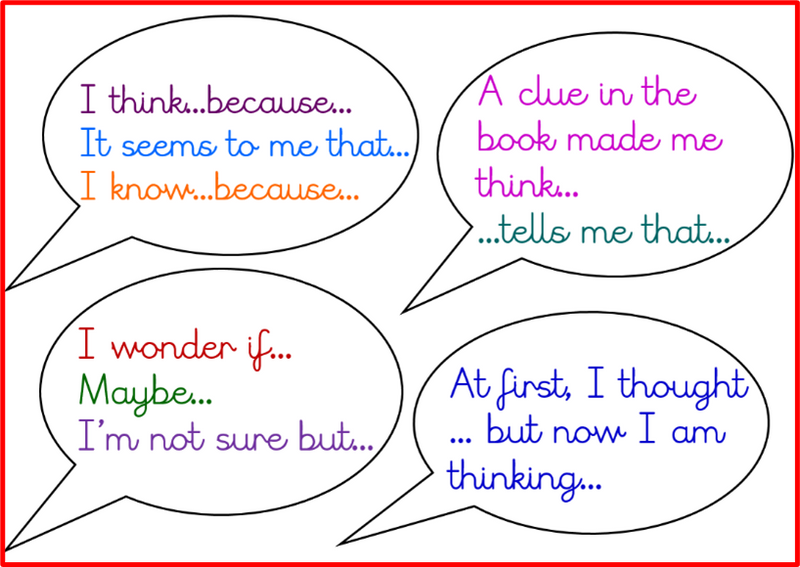
- Use sentence stems and key vocabulary to help children structure their talk and answers clearly and confidently.
- Learn key reading strategies such as predicting, clarifying, summarising and questioning.
- Answer a range of comprehension questions that encourage children to think critically and reflect on what they have read.
- Explore and discuss new vocabulary in context, helping children to expand their language and deepen their understanding of texts.
- Complete a variety of engaging follow-up tasks.
- Develop a love of reading by exploring themes, characters, and ideas that connect to children's lives and experiences.
As children move into upper KS2, they take on specific reading roles:
- Predictor – makes thoughtful guesses about what might happen next in the text.
- Clarifier – spots tricky words or confusing parts and helps to explain them.
- Questioner – asks questions to explore deeper meaning or details in the text.
- Summariser – retells the main points or key events in their own words.
Discussion and ‘book talk’ are at the heart of our approach to reading. Reciprocal Reading is all about exploring texts together through purposeful talk. When children discuss a book, sharing ideas, asking questions, making predictions, and summarising what they have read, they develop the deep thinking and language skills needed to truly understand a text.
These conversations not only support reading comprehension but also build confidence, vocabulary, and the ability to listen to and build on the ideas of others. This approach is closely linked to the Oracy Framework, which helps children learn to speak clearly, listen carefully and express their thoughts effectively, all vital life skills that begin with a love of reading.
Please see examples of our stem sentences below.
Accelerated Reader
From Years 2 to 6, our children use the Accelerated Reader programme to support their reading development. Teachers regularly assess each child’s reading level and the programme assigns a code to books that match their comprehension level. Children independently choose books within their range to enjoy and challenge themselves, fostering a sense of ownership and excitement about reading.
After finishing a book, children take a quiz to check how well they understood it, focusing on skills like deduction, inference, and interpretation.
We use Accelerated Reader results alongside 1:1 reading, our Reciprocal Reading sessions and formal termly assessments to get a full picture of each child’s progress. This multi-assessment approach helps us tailor reading support to every child’s needs.
Our School Library
At St Mary’s, we love to read and are extremely fortunate to have our very own school library and librarian! Our library is cared for by our amazing librarian and our dedicated student librarians. The children take great pride in organising the library and we all work together to keep it well-stocked with books we can enjoy as a community. We regularly audit the class libraries, recommend books to our friends and stay up-to-date with new releases to help us order fresh titles for our shelves.
Reading at Home
At St Mary’s we expect children to read regularly at home and record their reading in their Reading Record. Children will be given books to take home but we actively encourage children to read their own books or other library books which can be recorded in their Reading Records as well.
It is recommended that child reads 15+ minutes a day at home, we encourage a mixture of independent reading, child reading to an adult and an adult reading to a child. Even in KS2 a child benefits from hearing an adult read as it helps them to develop a strong reading voice with a focus on pronunciation and expression which in turn improves both their reading fluency and their ability to make inferences.
| Name | Format | ||
|---|---|---|---|
| Files | |||
| St Marys Reading St Marys Skills Progression.pdf |


